

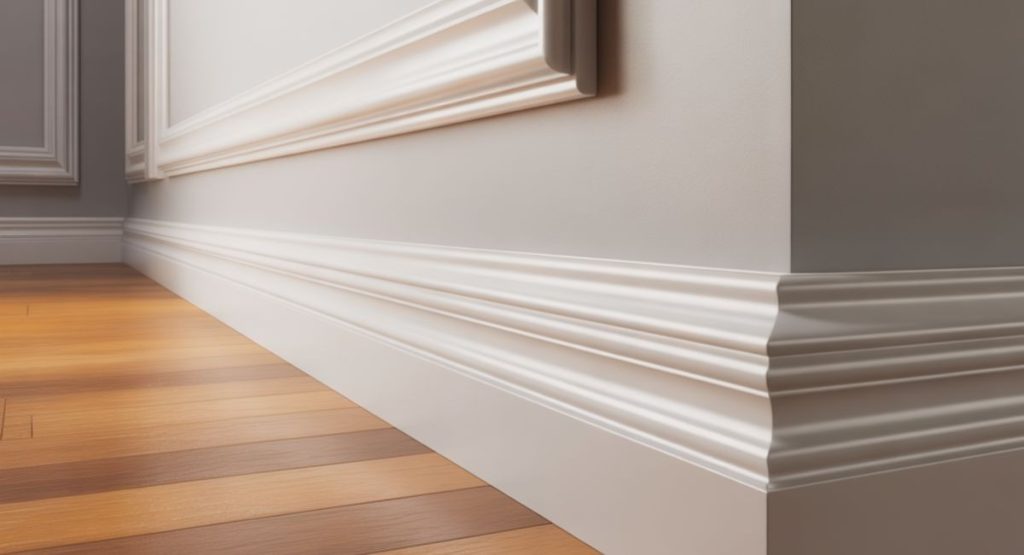
Skirting boards in Georgian style are crucial in any home renovation of a traditional or period home. These skirting boards are classics in profiles, have classic details, and they not only protect your walls, but also enhance the overall appearance of your interior spaces. Georgian style skirting boards provide both style and substance, whether it is restoring an old home or creating the quintessence of a contemporary abode.
What are Georgian Style Skirting Boards?
Georgian style skirting boards are decorative baseboards, which are used at the intersection of the wall and the floor. They are inspired by Georgian era architecture and incorporate the features of symmetry, proportion, and subtle shape of the moulded detail to produce a sophisticated finish. In contrast to the contemporary minimal boards, Georgian designs may be more curvy and have a floral or rococo influence that is reminiscent of the majesty of the 18th-century interiors.
Historical Origins and Design Influence
The Georgian era, which lasted between 1714 and 1830, focused on harmony as well as classical proportion in interior design. Skirting boards in Georgian style were a result of this aesthetic movement, and they featured profiles that were both symmetric and artistically detailed. The period was inspired by classical Greek and Roman architecture, and the mouldings were both balanced and elegant.
Common Materials Used in Georgian Skirting Boards
Georgian style skirting boards are made today of various materials to meet the needs of multiple budgets and of different performance requirements:
- Moisture-resistant MDF (Medium Density Fibreboard): This is a top seller because it is smooth, consistent in quality, and inexpensive. Primer and paint finishes can also be applied to MDF very well.
- Pine or Oak Wood: It is naturally beautiful and can be stained or painted. High-quality woodwork passes on conventional genuineness in old houses.
- High-Density Fibreboard and Composite Woods: These are more durable, particularly in wet conditions like kitchens and bathrooms.
All the materials have their advantages, and what makes them different is the objective of the project, preferences on budget, and finish.
Sizes, Profiles, and Custom Options
The Georgian skirting boards have many heights and lengths to suit any size of the room. The standard heights are 70mm to 400mm, which is determined by the choice of design; the standard length measures 3050mm and 4200mm.
The profile itself, the shaped outline at the top, is the same irrespective of the height, but as the board is made bigger, the plain flat base under the profile is also enlarged, and this adds a visual effect. Many manufacturers offer bespoke choices and cable rebates for covering up wiring or pipes.
Georgian Skirting Boards vs Modern Alternatives
Although a modern skirting board in more recent times has been the norm of minimalism with straight lines, the Georgian style skirting boards have been an ode to traditional design with:
- Curved or ogee profiles
- Classic moulded detailing
- The feeling of architectural depth and texture.
These are the qualities that make the Georgian boards the best choice in period properties, heritage restorations, and interiors that require the elegant appearance of refined elegance. The use of modern alternatives that are less ornamented, less complex, and less expensive would be more appropriate in modern homes where minimalism is desired.
Practical Benefits Beyond Aesthetics
Though Georgian style skirting boards are very decorative, they also have the practical benefit:
- Wall protection: These safeguard plasterwork against knocks, scuffs on furniture, and other forms of wear and tear.
- Hidden wiring: It is possible to rebate many profiles of Georgian to contain cables in order to have a discreet solution.
- Increases sale value: Traditional features that are period-appropriate can be desirable to traditional property purchasers.
- Complementary to other mouldings: Georgian skirtings go perfectly well with architraves, cornices, and dado rails to make up period interior schemes.
How to Measure for Georgian Skirting Boards
Georgian style skirting boards need to be ordered with accurate measurements:
- Measuring the perimeter of each room to obtain the summative lengths.
- Take into consideration angles and corners – inside and outside mitres will have an impact on the overall lengths of boards.
- Choose the height you would like according to the ceiling height and room ratios.
To facilitate accurate ordering, manufacturers usually give profiling directions and templates of measurements.
Georgian Style Skirting Board Fitting Guide
The installation of Georgian skirting boards is a complicated matter that needs to be carefully prepared and done:
Walls: Have walls prepared by removing old skirting and making sure that they are smooth.
Cut boards: With a mitre saw, make clean angled cuts.
Dry fit: Make sure every board is fixed.
Fix to the wall: use adhesive and nails or screws that suit the wall material.
Fill and finish: Fill joints and nail holes, then prime and paint for a flawless finish.
Installation is also professionally carried out, which gives ideal mitre joints and fixation, particularly on larger and heavier profiles.
Painting and Finishing Tips
To achieve a refined finish:
- Set up a high-quality primer, particularly on MDF, to provide a seal before topcoats.
- Two coats of your preferred paint are recommended to make it durable.
- Gloss finishes emphasise details, whereas satin or eggshell provides a less conspicuous classiness.
Numerous brands also offer pre-primed options, which save time and guarantee a uniform surface for painting.
Cost Considerations and Value
Georgian style skirting boards are available at many different prices depending on the material, length, thickness, and finish:
- MDF boards: The MDF boards are not the most expensive and may be of a lower entry level, or high-standard primed boards.
- Solid timber boards: More expensive and more natural, but need more finishing remedies.
Trade off between material and design objectives. Classic Georgian boards are a profitable investment that may add much character to the room and increase property value in the long term.
Conclusion: Timeless Elegance Meets Practical Design
Georgian style skirting boards could be regarded as an ideal combination of historical beauty and practicality. Ranging from the restoration of an old home to the search for a classical furniture-inspired interior decoration of a new structure, these skirting boards add a visual layer, architectural sophistication, and long-term wall security to the building.
Whether it is the choice of materials or installation and finishing, putting this vintage style in your decor will turn a simple space into the eloquently described rooms, which is a common gesture of good interior design.
